
People are like software, without which we could not restart ourselves.
Nov 8, 2024
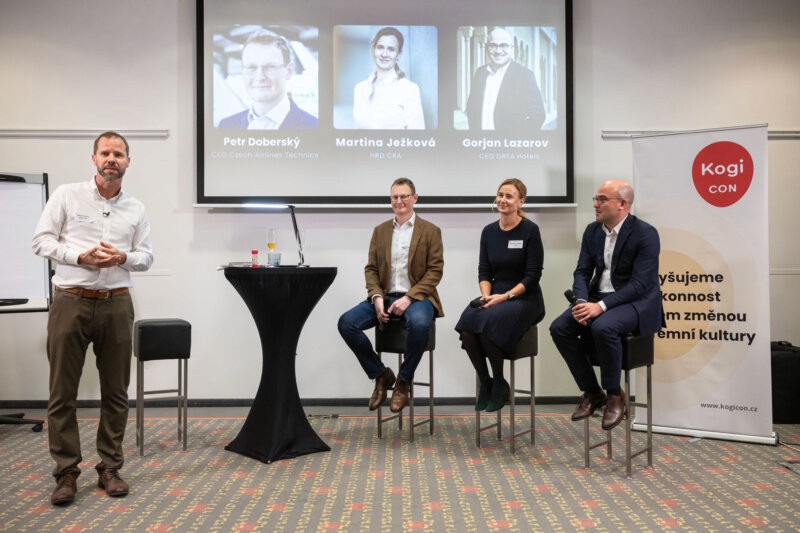
Martina Ježková, HR Director of Czech Radiocommunications, Gorjan Lazarov, CEO of OREA Hotels, and Petr Doberský, CEO of Czech Airlines Technics discussed during the celebration of the 10th anniversary of Kogi CON corporate culture, business transformation, and other topics that all CEOs have to deal with.
Read the transcript of the panel discussion
(the text has been paraphrased and shortened using ChatGPT)
Pavel Kuhn: To start the presentation, I will begin with the lady: Martina Ježková, currently the head of HR at Czech Radiocommunications. Historically, she has served in similar positions at Tchibo and Sportisimo. If I remember correctly, also at ING. I will reveal that she is a huge and active volleyball fan. Next is Petr Doberský, currently the head of Czech Airlines Technics, a maintenance company focused on aircraft. If you want to see six Boeings side by side, I recommend coordinating with Petr or his colleagues. Although I am not a big fan of flying, that view is very impressive. I will share two things about him: he likes to take long walks with his hunting dog, and his daughters made him stop in Seoul on his way to Asia because they love Korean pop music. And the last guest, our host, Goran Lazarov, head of OREA Hotels, who has a rich career connecting the unconnectable – telecommunications and hospitality. That’s where we also met. I will reveal that he loves tennis. And since the main theme of Kogi is corporate culture, I cannot help but ask my colleagues what corporate culture means to them.
Petr Doberský: Good day, for me it's actually very interesting. When we started working with Kogi last year, I imagined corporate culture mainly as working together, greeting each other, and being accommodating to one another – just such behavior. Paradoxically, I discovered that the topic is much broader. For instance, there is the OCAI matrix, which has helped us define what kind of company we want to be, whether more innovative or process-oriented. I must admit, this has opened my eyes. If the culture does not match the business, it actually goes against the grain, and the company is internally set up differently than the business requires. During the discussion with Kogi, this logically became clear to us. We are a large company in aviation, so we definitely do not want to be an experimental company – customers probably wouldn't appreciate that. We are process-oriented, and in this setting, we feel good.
However, we may be a bit too process-oriented and need to move slightly out of that box. We had a problem with employee collaboration; they mostly did not cooperate. In the end, we dealt with various rituals and behaviors. At first, I thought, what is this nonsense again, but I had to admit that this methodology makes sense. Only over time did I understand its essence. It was interesting for me to discover that corporate culture is a much broader topic than just collaboration.
Gorjan Lazarov: Corporate culture is the cornerstone of the company because it shapes people's behavior based on values. When I look at OREA's transformation journey, we have tried to unify the values we believe in – care, innovation, trust. That is what has moved us forward because when you have clear values, a common goal, and a way to behave towards each other, you can achieve anything. When I started, I thought like a doctor. OREA was like a patient in a coma. The goal is clear: save the patient; you do not deal with the details at that moment. Just before COVID, we invested a billion in the product. Initially, we wanted to fix the software, which consists of our employees who take care of clients, and only then the hardware. Once we finished the hardware, COVID came along, giving me time to think about everything I was doing wrong.
I discovered that we lack structure in how we perceive corporate culture and how we measure it. I'm glad we started working with Kogi on a project that has pushed us even further. We emerged from COVID stronger and are achieving record numbers.
Martina Ježková: For me, corporate culture is the driving force behind strategy. Strategy is a path on the map, and corporate culture is the engine that drives us along it. I have experienced an extremely strong corporate culture at Tchibo, which was self-cleaning. The values were clear, making our job as management easier. Teams would take a new person in, but once they did not function according to the values, they would stop collaborating with them. This is the power of culture. When I took over Czech Radiocommunications six months ago, I received materials for a project that started a year and a half ago in cooperation with Kogi. The project was professionally launched, and I believe we will advance corporate culture further once it becomes functional and self-cleaning. However, we must protect that culture.
Pavel Kuhn: The second question is whether you perceive that the topic of corporate culture is changing over time. Is its urgency changing in context with what is happening outside or inside the companies? Is it necessary to pay more attention to corporate culture than, for example, before COVID?
Gorjan Lazarov: I definitely think so. Everything happening around us – maybe it started with COVID, then came uncertainty, geopolitical changes, the invasion of Russia. Since the 1990s, we have lived in the idea of building a global world that is slowly falling apart today. Why? Because people have different values. That's also why this topic is important today. Corporate culture is not just about values. The worst corporate culture creates great posters, hangs them around the company, but that’s where it ends. For us, care is one of the fundamental values. During COVID, we actually fought for survival. When government measures came in, and the company could switch to 60% salaries, we kept employees at 100% salary. We knew that people with lower incomes would get into trouble. In the end, it cost us tens of millions. I remember long discussions about whether to really do it. We had just made a billion investment. If you added twenty million to a billion project, everyone would say, "fine," but twenty million for people? Few would invest in that.
For us, it was a bet. Either the world of hospitality collapses, and we have a problem, or it returns. In that case, we had to view it as part of the investment because we had the hardware, but if we destroy that "software" – our employees – we cannot fix it.
Martina Ježková: I believe that the need for corporate culture is truly increasing. It has a direct impact on productivity and reducing turnover. Many studies have been conducted on this, for example, by Gallup in 2020. For companies operating in a competitive environment, corporate culture is essential. Another factor is the new generation, which expects to work in responsible and cultured companies with a significant CSR program. Inclusion is also playing an increasingly important role. We want to feel good regardless of gender, religion, or anything else and be respected. These are the reasons why corporate culture should receive attention.
Petr Doberský: We are probably twenty years behind you. We are a repair company; we have one female mechanic and 250 mechanics. So we really cherish that one female mechanic, so we can put her on posters and show that we have a woman working with us. The second one became pregnant and we hope she will return one day. We are at ground zero. Last year we were in a phase of complete turmoil in the company. The first phase was something like marriage counseling, mainly to get employees to believe that something would change and that someone would start caring for them. I think it is gradually succeeding. In the 1990s, the leadership style was tough, perhaps because people were grateful for their jobs and had few options. Today, that has changed. If the company does not communicate with people, does not collaborate, and is not transparent, it is a problem. Today, things can't be done harshly. And that was our case too. The guys completely stood up against it, refused to cooperate, and that was it.
Pavel Kuhn: In the field of culture, you are evangelicals and believe that it is right to focus on it. Do you see a way to translate culture into business results for which you are responsible?
Petr Doberský: I need it to work. In the end, there is money behind all of this. We have a lot of projects; we constantly deal with it, and it is funny because even though we said something a year ago, it took a long time for people to come to terms with it. If we had pushed it directly, nothing would have happened. We can't just fire everyone and replace them with new ones. So it took longer. But we are not a social club. We are a company that has to make money – that’s why we are all there. In the end, people will be happy about it because they contribute to the company's success and will receive rewards.
Gorjan Lazarov: I personally believe that corporate culture is fundamental. When you look at management, it’s about whether you “drive by the rearview mirror,” that is, by results, or whether you focus on corporate culture and a common goal. We ask ourselves, "What is Orea?" Sometimes I jokingly say, "Elon Musk makes electric cars; we make joy." And when we create joy, it depends on people. We don’t want McDonald’s, where everything is perfectly set up and works well, but if you want to differentiate yourself by customer experience, corporate culture is significant. And so far, it has numerically worked out well for us.
Martina Ježková: I believe it works. A strong corporate culture truly influences results, so I have both. Besides being a volleyball fan, I also coach it – this is a subculture with its own culture. It is essential for me that the girls are team players and combative. These are values we instill in them from an early age. I need parents to cooperate and support us. Recently, in our WhatsApp group, a father reacted inappropriately, and the group civilizedly directed him. We coaches did not have to intervene at all. I think this is a sign of a strong culture. We do this so that the girls enjoy it, but we also want results. I perceive this the same way in the company – I believe it works, and that’s why we do it.
Pavel Kuhn: How do you cope with having five generations in the workplace today?
Martina Ježková: We are missing the younger generation, which is one of the reasons why we need to work on employer branding to attract young people.
Gorjan Lazarov: We have young people. Each generation has different needs, which is clear. The younger generation wants more flexibility, so corporate culture is an essential connecting element for us. Our culture connects different generations, which is also reflected in customer feedback. When I took over the luxury Boscolo hotel in 2011, the Italian owner said that Czechs do not know customer service. It turned out that this is not true – Czechs can improvise as well as follow rules, which contributes to good service and balances the differences between generations.
Petr Doberský: We have young people, it’s not that bad. Moreover, there is a love for airplanes and technology among us, so the young look up to more experienced colleagues who really understand aircraft. Experience is important here, but we must ensure that the older ones do not transfer their “habits” to the young.
Pavel Kuhn: Thank you. Gorjan, do you see any connection between employee and customer satisfaction?
Gorjan Lazarov: Absolutely. At the end of 2016, I decided that we would reward based on customer satisfaction, and that CEOs would receive bonuses once a year, not quarterly. This stopped the "playing with numbers" and we began to focus on long-term customer satisfaction. This approach – that a satisfied and motivated employee brings a satisfied guest – still works today.
Pavel Kuhn: What has been the hardest for you in shaping corporate culture?
Gorjan Lazarov: Trust is key. When you change something, it is essential to earn people's trust.
Petr Doberský: I had a similar experience. I had to stand before gloomy guys who had been in the company for 30 years and explain that the changes are real and will also benefit them. We need to collaborate; otherwise, the company will not survive.
Martina Ježková: The hardest part is convincing managers and directors not to compromise on cultural issues.
Pavel Kuhn: I like to say that I only work for IT companies – some of them also provide guest services, others ICT services, or repair airplanes. How do you develop digital skills across the company outside of the IT department?
Petr Doberský: It’s similar to car repair for us. Everything follows manuals, often printed, and people follow them. We would like them to eventually have glasses with digital instructions right in front of them, but for now, technology adoption is slower.
Gorjan Lazarov: We are at the beginning. We measure employee motivation and engagement, have a feedback platform, and are developing digital projects for guests that should enhance service personalization.
Martina Ježková: We are also at the beginning, and so far, we approach digitalization and skill development relatively opportunistically.
Pavel Kuhn: Thank you very much for your very honest answers.