Companies are not looking for a better culture. They are looking for a culture that keeps up with reality.
Jan 7, 2026
Before the end of the year, I took a thorough look at the shift in corporate cultures. I used our own data outputs from measuring corporate culture that we have collected over the last three years. Dozens of organizations, different sectors, various stages of development. And a very consistent picture.
Due to signed NDAs, we cannot talk about specific companies or their numbers. However, I can speak about what recurs across the data. About the direction in which culture is truly moving where companies encounter the limits of old functioning. And that direction is much less ideological than it might seem from public debate.
The more data I stack next to each other, the clearer I see that changing culture today is not a matter of value awakening or leadership enlightenment. It is a reaction of the system to the pressure of the environment: acceleration of cycles, digitalization, automation, the rise of AI, and the increasing complexity of decision-making. Companies do not change their culture because they want to be "modern." They change it because the old cultural mix has stopped delivering performance.
This text is therefore not a manifesto about what culture should be. It is a map of the real shift that I see in the data today. Without comfortable shortcuts that make culture either a marketing slogan or a therapeutic project.
Map of the real shift in corporate cultures in times of acceleration
Corporate culture is often described today in the language of values, authenticity, and "new leadership." However, the reality of culture change in organizations has little in common with ideology. When we look at long-term measurements of corporate cultures across sectors, we see a different picture: culture changes when the old way of functioning stops delivering performance under new conditions. It is not about a moral turnaround or a generational rebellion. It is about the adaptation of the organizational system to changes in the environment.
To read this shift without simplifications and shortcuts, it is necessary to look at culture not as a set of declared values, but as an architecture of decision-making, management, and collaboration. That is why it makes sense to work with the OCAI model, which we have long used in Kogi. Not as a typology of companies, but as a map of tensions that organizational leadership must manage daily.
The OCAI model is often reduced to labels: clan, creative, process, market. In practice, it does not answer the question of "what kind of company it is," but rather what compromises its culture must manage long-term. Each axis of OCAI represents a strategic tension:
stability vs. flexibility
performance pressure vs. relational cohesion
Companies never stand at one pole. They only optimize the ratio of strengths according to the environment in which they operate. And right here, a very consistent shift is visible today.
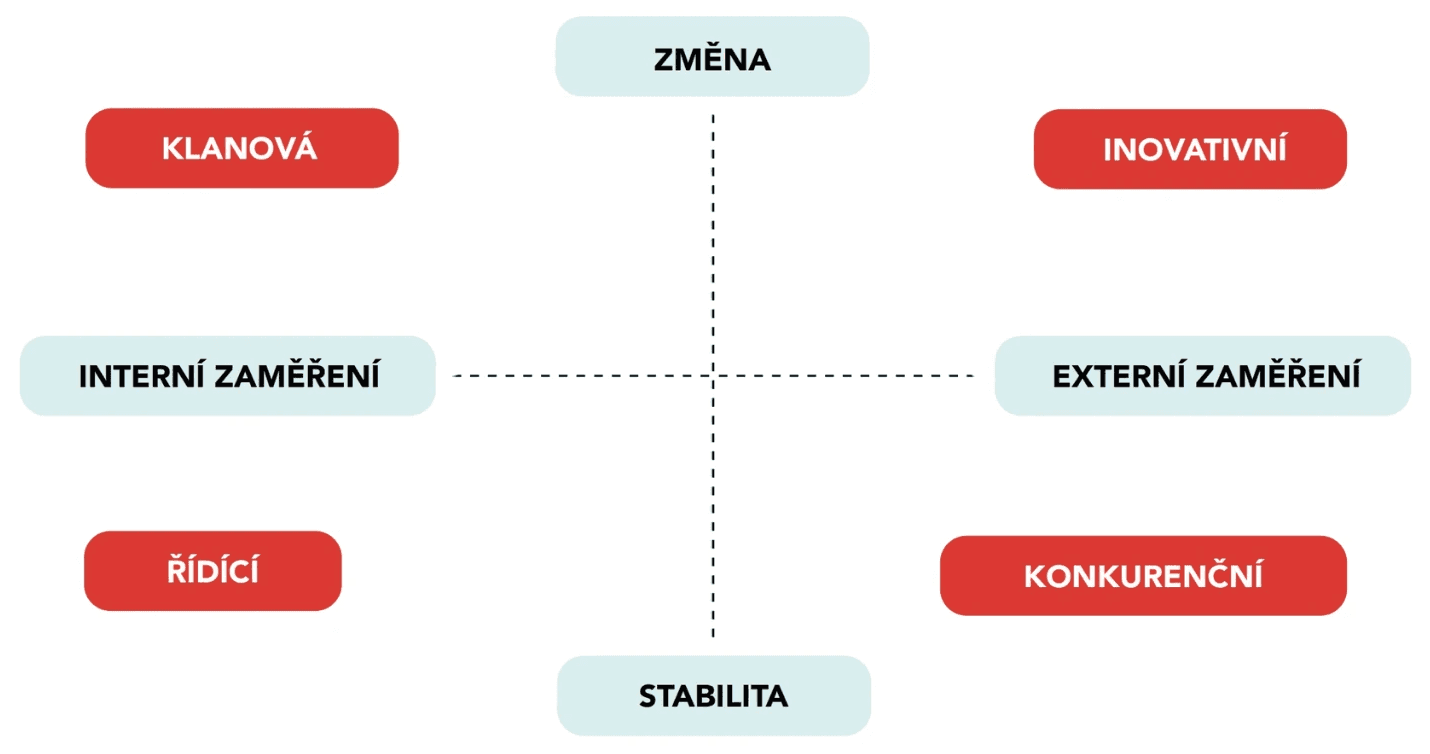
Clear trend in corporate culture: from stability to flexibility
Across the portfolio of organizations (regardless of size or sector), we see a systematic weakening of process and hierarchical dominance and a strengthening of elements of creativity, autonomy, and learning.
Not because processes are bad. But because they have stopped scaling reality.
Digitalization, automation, and the rise of AI have dramatically shortened:
product cycles
decision loops
the distance between the customer and the impact of decisions
What previously created certainty and control often now generates:
friction in time to market
high change costs
slow response to market signals
The result is not chaos, but a shift towards creative elements: experimentation, customer proximity in responsibility, rapid learning, team autonomy.
Innovation is not the opposite of discipline. It is the opposite of unnecessary discipline.
Processes and performance remain. The way they operate changes.
A common misconception is the idea that the shift towards creativity means "the breakdown of order." Real data shows the opposite. Successful organizations do not disrupt processes – they streamline them and subordinate them to the goal of delivering value quickly.
The process transitions from a control tool to a bearer of quality, a protection against systemic errors, and a platform for scaling innovation. In other words: the process should safeguard risk, not hinder change.
On the market vs. clan culture axis, the picture is less dramatic, but no less important. Performance pressure has not disappeared from organizations, nor can it. However, the style in which performance is enforced and coordinated has changed. Instead of internal competitiveness, silo effects, and top-down directive pressure, we often see collaboration across teams, sharing of know-how, and team responsibility for results. The clan component does not grow as a "soft benefit." It grows as a stabilizer in an environment of constant change.
Relationality is not cultivated for comfort today. It is used to ensure that the system can withstand the load.
Overall picture: flexibility is increasing, performance remains
When we piece the data together, a fairly clear picture of the current development of corporate cultures emerges:
flexibility is systematically increasing
performance orientation remains
clan culture serves as a safeguard for cohesion
processes are being reconstructed, not removed
Companies are not looking for a "nicer culture." They are looking for a functional cultural architecture for a world of acceleration, uncertainty, and technological leaps.
And this is where the greatest risk arises: not in the fact that companies are changing too quickly, but that they copy foreign cultural models without understanding their own compromises.
True cultural leadership today does not lie in telling people what kind of culture they should want. It lies in leaders being able to read systemic data, understanding the tensions that culture inevitably carries, and having the courage to openly admit that there is no universal correct solution, only solutions that are functional in a given context.
Culture does not move due to ideological change. It moves out of necessity.
And only those who can articulate this necessity without illusions, without shortcuts, and without the need to please, will be able to manage culture not as a pretty story about values, but as a real source of long-term performance and adaptability.