

In 2012, researchers from the University of Wisconsin-Madison published a study that forced part of the scientific community to rethink what we actually know about stress. They tracked over 28,000 American adults for eight years, asking them two basic questions: how much stress had they experienced over the past year, and did they believe stress was harmful to their health?
The result was unexpected.
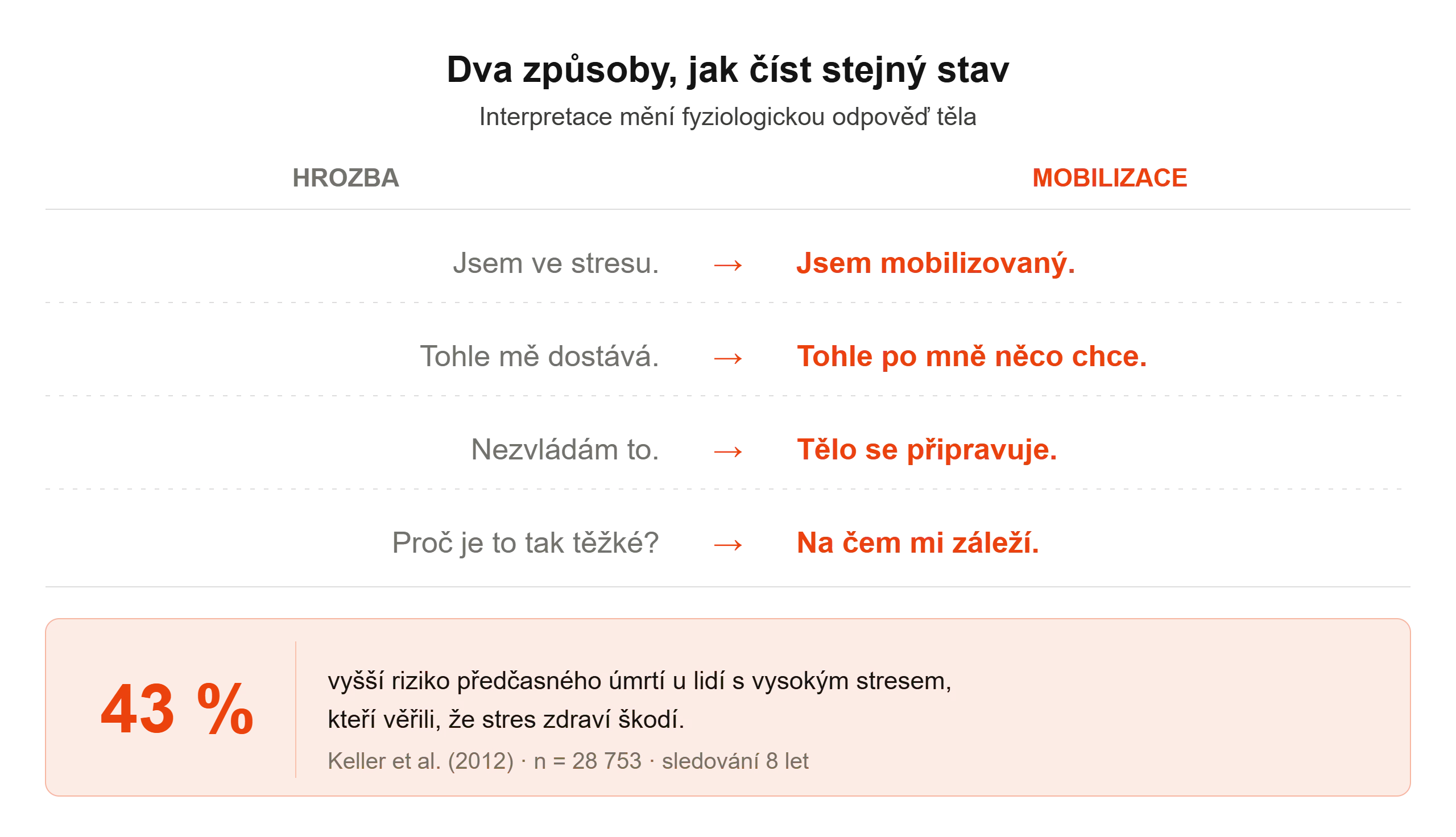
People experiencing high levels of stress who also believed that stress was damaging their health had a 43 percent higher risk of premature death than average. But people with the exact same high levels of stress who did not view stress as harmful had the lowest risk of death of any group in the study—including those who lived relatively stress-free lives.
The problem was not the stress itself. It was the story they were telling themselves about it.
What This Means Physiologically
Stress is not an enemy. It is a signal. The body registers a situation as demanding and mobilizes resources: heart rate accelerates, focus sharpens, and cortisol levels rise. Evolutionarily, this mechanism helps us survive. The problem arises when we interpret this signal as failure or a threat rather than as preparation.
Psychologist Kelly McGonigal, who popularized the Wisconsin research in her 2013 TED talk, frames it this way: if, in a moment of stress, you interpret a pounding heart as energy rather than panic, the body's physiological response literally changes. Blood vessels stay more relaxed, and the cardiovascular profile aligns more closely with courage than with fear.
This is not self-suggestion; it is about how the nervous system reads context.
Healthy vs. Toxic Pressure
This distinction is not meant to justify workplace overload. There is a real boundary beyond which stress stops mobilizing and starts damaging. Chronic overload without room for recovery, a lack of control over the situation, and repeated failure without feedback are conditions where stress becomes toxic, regardless of your mindset.
The difference lies in the nature of the strain. Short-term, intense pressure with a clear purpose and a visible end acts differently than persistent pressure without boundaries, meaning, or results. A manager facing a tough board presentation experiences a different kind of stress than a manager who does not know if their department will exist in three months.
Reframing stress as mobilization works for the first scenario. For the second, the correct answer is changing the situation, not changing your interpretation.
Why This Is Relevant to Leadership
Managers are in a unique position: they experience stress themselves while simultaneously shaping how their entire team processes it through their own attitude toward it.
Organizations where stress is discussed strictly as a threat produce people who feel ashamed of their own overload or hide it. The result is not a more resilient team; it is a team where problems surface too late and exhaustion is masked by performance until it becomes impossible to sustain.
Conversely, a culture where a leader can say "this project was demanding and I felt it," while demonstrating that they handled it, normalizes stress as a natural part of meaningful work—not as a weakness, and not as an anomaly.
A Practical Shift, Not a Philosophical One
Applying this insight does not require a program or a workshop. It requires a single shift in language.
Instead of "I'm stressed," try "I'm mobilized." Instead of "this is getting to me," try "this is asking something of me." The difference sounds like a semantic game, but research suggests that for the nervous system, it is anything but.
The language we use to describe our state is not just a description. It is an instruction for how the body continues to process it.
Data in this article is based on the study by Keller et al. (2012), "Does the Perception That Stress Affects Health Matter?", Health Psychology, 31(5). The research was popularized by Kelly McGonigal at TEDGlobal 2013.